
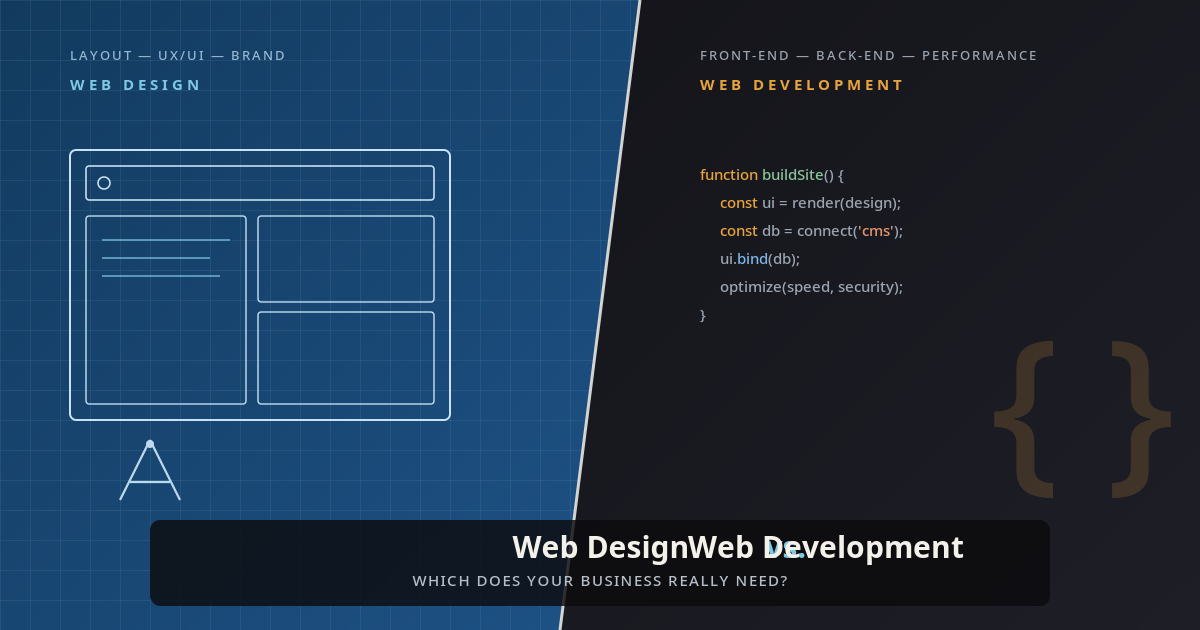
If you’ve started researching how to build or improve your business website, you’ve probably run into two terms that get thrown around interchangeably: web design and web development. They sound similar, they’re often bundled together in service packages, and many agencies blur the line between them — but they are not the same thing.
Understanding the difference between web design and web development isn’t just a semantic exercise. It affects who you hire, how much you budget, what timeline to expect, and ultimately whether your website actually works the way your business needs it to. This guide breaks down both disciplines, shows where they overlap, and helps you figure out which one (or both) your business needs right now.
What Is Web Design?
Web design is the visual and experiential side of building a website. A web designer focuses on how a site looks, feels, and flows for the person using it. Think of a web designer as the architect who decides where the doors, windows, and hallways go before anyone starts pouring concrete.
Web design typically covers:
- Layout and structure – how content, images, and navigation are arranged on the page
- Color palette and typography – choices that reflect your brand identity
- User experience (UX) – making sure visitors can find what they need without friction
- User interface (UI) – buttons, menus, forms, and other interactive elements
- Wireframes and mockups – blueprints of the site before development begins
- Branding consistency – logo placement, imagery style, and overall visual tone
A good web designer thinks like a psychologist and an artist at the same time. They’re asking: Will a visitor understand what to do next? Does this page build trust? Does it match how our audience expects a business like ours to present itself?
Common tools used in web design include Figma, Adobe XD, and Sketch — all used to plan and prototype a site before a single line of code is written.
What Is Web Development?
Web development is the technical, functional side of building a website. If design is the blueprint, development is the construction crew that makes the blueprint real — wiring the electricity, laying the plumbing, and making sure the building actually stands up.
Web development typically covers:
- Front-end development – turning design files into functioning code (HTML, CSS, JavaScript) that runs in the browser
- Back-end development – server-side logic, databases, and application functionality
- Content Management System (CMS) setup – platforms like WordPress, Shopify, or a custom-built system
- E-commerce functionality – shopping carts, payment gateways, inventory syncing
- Site speed and performance – optimizing load times and technical SEO factors
- Security – SSL certificates, data protection, and vulnerability management
- Integrations – connecting your site to CRMs, booking tools, email platforms, and analytics
A web developer thinks like an engineer. Their questions sound more like: Will this page load fast on mobile? Is the checkout process secure? Can the database handle traffic spikes? Does this integrate with our existing software?
Web Design vs. Web Development: The Core Difference
Here’s the simplest way to remember it:
| Web Design | Web Development | |
|---|---|---|
| Focus | Look, feel, and user experience | Function, structure, and technical performance |
| Output | Mockups, wireframes, visual layout | Working, coded website |
| Skills | Visual design, UX/UI, branding | Programming languages, databases, servers |
| Tools | Figma, Adobe XD, Canva | HTML/CSS, JavaScript, PHP, Python, CMS platforms |
| Analogy | Architect and interior designer | Construction crew and engineer |
Design answers “how should this look and feel?” Development answers “how does this actually work?” A great website needs both working in sync — a beautifully designed site that doesn’t function properly will frustrate visitors, and a technically flawless site with poor design will fail to engage them in the first place.
Which One Does Your Business Actually Need?
This depends entirely on where you are right now. Here are the most common scenarios:
You need web design if:
- You already have a functioning website, but it looks outdated or doesn’t reflect your brand
- Visitors aren’t engaging, and you suspect it’s a usability or first-impression issue
- You’re rebranding and need your site’s visuals to match a new identity
- You want a better user experience to reduce bounce rates
You need web development if:
- Your site is slow, broken, or has technical errors
- You need custom functionality, such as booking systems, membership portals, or e-commerce
- You’re integrating your website with other business tools
- Your current site isn’t mobile-friendly or secure
You need both if:
- You’re building a brand-new website from scratch
- You’re doing a full website redesign or migration to a new platform
- Your current site has both an outdated look and technical limitations
Most small and mid-sized businesses building a new site from the ground up need both disciplines working together — which is why many local web agencies offer combined design-and-development packages rather than making clients hire two separate specialists.
Choosing Between a Freelancer, an Agency, or a Local Web Design and Development Company
Once you know what you need, the next decision is who builds it:
- Freelance designer or developer – Good for smaller, well-defined projects with a limited budget, but you may need to hire both a designer and a developer separately.
- Full-service digital agency – Offers both design and development under one roof, useful for businesses that want a single point of contact and a cohesive final product.
- Local web design and development company – Often a strong choice for small businesses that want face-to-face collaboration, faster communication, and a partner who understands the local market and customer base.
If you’re a local business — a clinic, law firm, restaurant, or retail store — working with a local web design and development team can be especially valuable. They understand regional search behavior, can meet in person for strategy sessions, and often have experience building sites optimized for “near me” searches and local SEO, which matters if most of your customers are searching for businesses in your area.
Final Thoughts
Web design and web development are two halves of the same whole. Design shapes how your business is perceived in the first three seconds someone lands on your site. Development determines whether that site actually works — loads quickly, functions smoothly, and supports your business goals behind the scenes.
Before hiring anyone, get clear on which problem you’re actually solving: is it how your site looks, how it functions, or both? That clarity will save you time, budget, and a lot of back-and-forth — and it’ll help you find the right web design and development partner, whether that’s a freelancer, an agency, or a trusted local team.